Historical Reviews
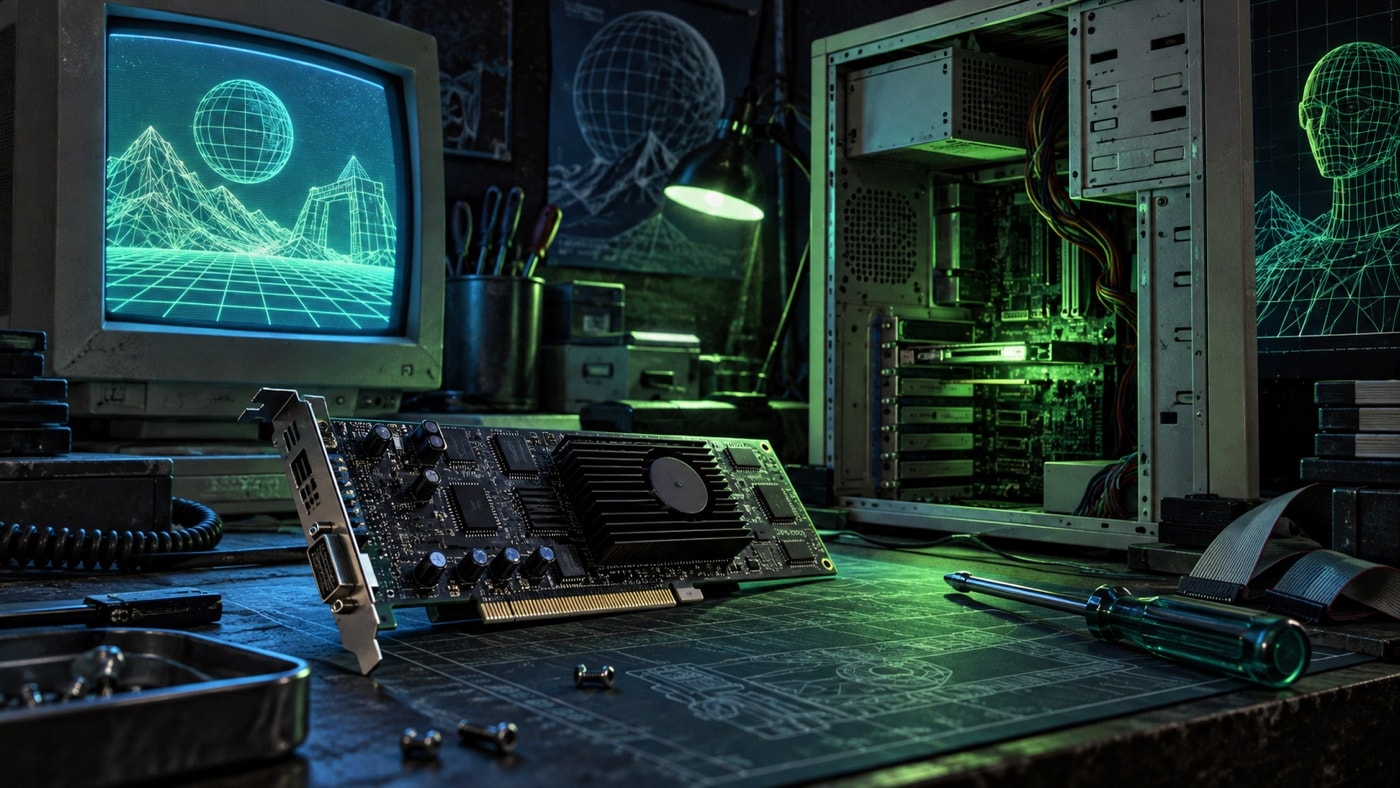
Reviews gave 3DChipset room to move beyond a release headline. Coverage spanned graphics cards, display features, cooling, memory, power supplies, and storage—always through the practical concerns of a PC enthusiast.
The original graphics focus
Early reviews covered the Matrox Millennium G400, GeForce and GeForce2 products, ATi Rage and Radeon cards, 3dfx Voodoo hardware, and competing designs from S3, PowerVR, and 3Dlabs. Coverage included the All-In-Wonder Radeon 8500DV and VisionTek GeForce2 GTS 64 MB.
Those subjects demanded more than a benchmark table. A useful card review considered output connectors, display quality, driver behavior, cooling, board size, bundled software, and performance across resolutions and color depths. Multimedia boards added television input, DVD, remote-control, or dual-display questions. Workstation-oriented cards emphasized output quality and multi-monitor workflows.
How the bench changed
By the middle of the decade, reviews had expanded into memory, cooling, power and flash storage. Recorded titles included OCZ value DDR400 and DDR500 memory reviews, a pair of 520-watt power-supply reviews, a 2 GB USB flash-memory review, and a GPU air cooler. These third-party product names identify the historical test subjects; they do not imply endorsement or a present commercial relationship.
Questions a period review had to answer
- Test context: Which CPU, motherboard, operating system, driver, resolution, and API were used?
- Output quality: Were desktop text, analog output, television output, filtering, and antialiasing examined?
- Physical fit: Did a cooler block another slot, and did the board fit common cases?
- Noise and heat: Was added cooling audible, effective, or merely decorative?
- Value: Did extra memory, connectors, or bundled software change the audience for the product?
The key is comparability. A number means little if two cards render different settings, use different driver paths, or run on mismatched systems. This was the basis of many 3DChipset arguments in 2002 and 2003, and it remains a sound way to read old results.
What this index does not do
Unsupported verdicts or benchmark figures should not be inferred. Box art and manufacturer photography are not technical evidence, and this material is not buying advice. The glossary, timeline, and reader discussions explain recurring review concepts.
A wider historical lens
Consumer 3D accelerated quickly because chips, APIs, memory, displays, and game engines advanced together. The Computer History Museum’s graphics-and-games timeline places the 3dfx Voodoo chip within a wider sequence of computing milestones. 3DChipset’s own review trail shows how those industry changes reached an enthusiast’s desk.
Building a fair period comparison
A useful review began by defining the system: processor, motherboard chipset, memory, operating system, driver version, and display settings. Game tests needed both resolution and color depth, while antialiasing and texture-filtering comparisons needed clearly matched quality modes. Without those details, a large score difference could reflect configuration as easily as hardware.
Reviewers also had to choose competitors by price, release date, and intended use rather than processor name alone. Retail boards built around the same chip could differ in memory, connectors, cooling, clocks, and bundle. Board-level features and software maturity are part of the product, not footnotes to a benchmark graph.
What remains useful now
Old reviews document what users valued and what test methods were available at the time. Their absolute performance numbers are not current buying advice, but their descriptions can identify ports, feature support, driver behavior, and the sequence of a product family. Those observations are presented as dated editorial history, without prices or purchase prompts.